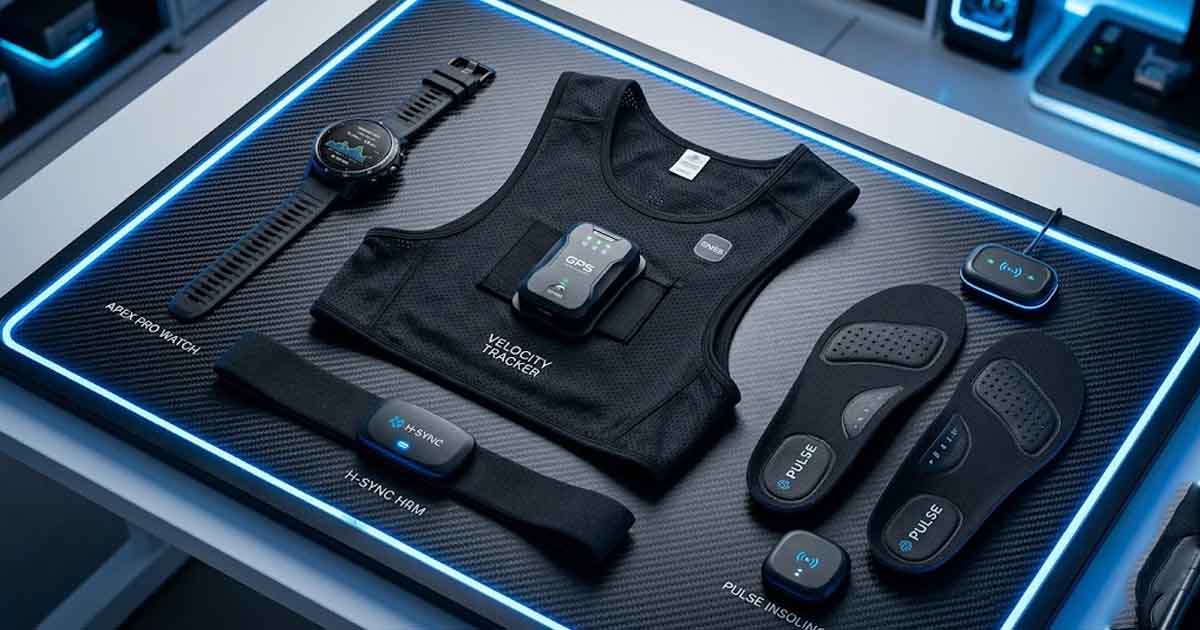
The wearable sports technology market has undergone a transformation over the past five years that places capabilities once reserved for laboratory physiologists directly on the bodies of athletes at every level of sport. In 2026, a serious recreational athlete can access heart rate variability monitoring, sleep quality analysis, GPS movement tracking, blood oxygen measurement, and even continuous glucose monitoring through consumer devices that fit on a wrist or clip to a shirt.
For professional athletes and their support teams, the technology landscape is even more sophisticated — and the data it generates has become central to training planning, injury prevention, and performance optimization. This review examines the most significant wearable technologies across key categories, evaluating both the hardware and the quality of insight they can realistically provide.
GPS Vests and Tracking Pods: Team Sport Essentials
GPS tracking vests — worn under the training kit in a tight-fitting harness that positions a tracking pod between the shoulder blades — are now standard equipment at every professional club in football, rugby, and Australian Rules football. The devices track position, distance covered, speed zones, acceleration and deceleration events, and changes of direction throughout training sessions and matches.
Catapult and STATSports are the dominant players in this market, with their systems deployed at the majority of Premier League clubs and internationally. Their platforms process raw GPS and accelerometer data into training load metrics — particularly the ACWR (acute to chronic workload ratio) framework that quantifies the relationship between recent training load and training history, which is the most validated predictor of soft tissue injury risk in team sports.
Heart Rate Variability Monitors: The Recovery Revolution
Heart rate variability — the subtle variation in time between heartbeats that reflects the autonomic nervous system's balance between sympathetic arousal and parasympathetic recovery — has become the most popular physiological marker of training readiness and recovery status among elite athletes. When HRV is elevated relative to an athlete's personal baseline, the parasympathetic system is dominant — indicating good recovery and readiness for high-intensity training. When HRV is suppressed, the sympathetic system is dominant — indicating incomplete recovery and elevated risk from intensive training loads.
The Whoop strap and the Oura ring are the consumer devices that have popularized HRV monitoring, while professional teams use medical-grade devices like the Polar H10 chest strap for higher-precision measurement. The key to interpreting HRV data effectively is individualization — comparing each athlete's daily readings to their own personal baseline rather than to population norms, because natural HRV levels vary enormously between individuals.
Smart Insoles: Ground Reaction Force Monitoring
Smart insoles — pressure-sensitive insoles inserted into athletic footwear that measure the forces generated during running, jumping, and cutting movements — represent one of the most clinically useful wearable technologies for injury prevention. By quantifying asymmetries in ground reaction forces between left and right limbs, smart insoles can identify gait compensations that often precede overuse injuries in the foot, ankle, knee, and hip.
Nurvv Run insoles and Moticon insoles are among the leading devices in this category, offering real-time feedback on metrics including cadence, footstrike pattern, pronation, and power asymmetry. For athletes returning from lower-limb injuries, smart insole data provides objective evidence of movement symmetry that complements the clinical assessments used in return-to-sport decision making.
Continuous Glucose Monitors: Nutrition Optimization
Continuous glucose monitors — devices that measure blood glucose levels in real time through a sensor inserted just under the skin — have migrated from their original clinical application in diabetes management to sports performance nutrition. In 2026, CGM devices from companies including Levels and Supersapiens are used by a growing number of elite endurance athletes and team sport players to understand how their blood glucose responds to different foods, training sessions, and recovery periods.
The data from CGMs enables genuinely personalized nutrition planning — understanding which pre-training meals maintain glucose stability through a session, which post-training nutrition choices optimize glycogen replenishment, and how sleep quality affects overnight glucose regulation. This level of nutritional precision was simply not achievable before CGM technology, and its application in sport is still in early stages but already generating significant interest from sports dietitians and performance nutritionists.


Add a Comment