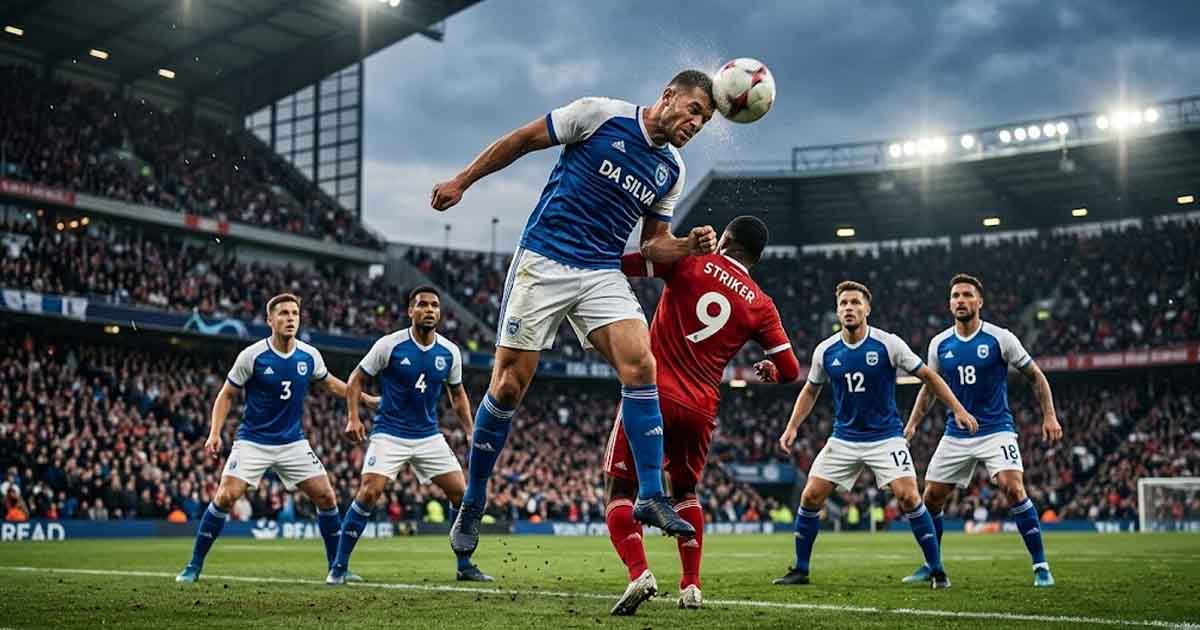
The defensive positions in football — central defenders and fullbacks — are physically demanding in ways that differ fundamentally from the more widely discussed demands of attacking and midfield play. While goals generate the headlines, defensive excellence requires a specific combination of physical qualities that is rarely analyzed in as much detail as the characteristics that produce offensive output.
This guide examines the position-specific physical demands of central defending and fullback play, and presents a structured training approach for developing the qualities that make defenders excellent.
Central Defending: The Physical Profile
The central defender's physical profile is dominated by three qualities: aerial ability and jumping power, the capacity to read play and position efficiently to minimize sprint demands, and the explosive acceleration needed to recover when beaten. Total distance covered by central defenders in elite football — typically 9-11 kilometers per match — is lower than midfield positions, but this understates the quality of the physical demands they face.
The aerial battle is the defining physical contest of central defending. Success in aerial duels depends on three components: jump height (the maximum vertical displacement achievable), jump timing (the ability to coordinate takeoff with ball flight), and physical presence (the ability to hold position and dominate the aerial zone against challenging opponents). Jump training for central defenders therefore addresses all three: vertical jump development through plyometric training, tactical jumping practice through repetitive heading drills, and physical robustness through upper body and core strengthening.
Jumping and Plyometric Training
Vertical jump performance in defenders is enhanced through progressive plyometric training — exercises that develop the stretch-shortening cycle, the rapid transition between muscle lengthening and shortening that produces explosive power. Box jumps, depth jumps, and repeated hurdle jumps develop the reactive strength that enables maximum jump height. Single-leg plyometric work develops the unilateral power that underlies the jumping ability in aerial challenges, where takeoff is frequently from one foot rather than two.
The progression of jumping training for defenders should move from bilateral (two-foot) to unilateral (one-foot) exercises, from sub-maximal to maximal effort, and from controlled to reactive environments. The final stage of aerial training — practice heading under competitive pressure from a challenging opponent in a game-realistic environment — is the only way to fully develop the timing and positioning components of aerial ability.
Fullback Training: Combining Defensive Solidity and Attacking Threat
Modern fullbacks are among the most athletically demanding positions in football. The evolution of the role over the past decade has seen fullbacks transform from primarily defensive specialists into genuine attacking threats who cover enormous distances, combine aerial and one-on-one defensive ability with the speed and crossing quality of wide attackers, and regularly appear in both penalty areas across 90 minutes of high-intensity play.
The physical demands of the modern fullback role therefore combine the sprint and speed endurance of a wide midfielder with the defensive robustness and one-on-one ability of a central defender. Training for fullbacks must address: repeated sprint capacity (the ability to make overlapping attacking runs and recover defensively multiple times across a match), one-on-one defensive mechanics (body positioning, the controlled approach to prevent cutting inside, and the timing of the defensive challenge), and crossing mechanics (the technical and physical ability to deliver quality crosses from high-speed positions).
The Defensive Line: Coordination as a Physical Skill
One of the most underappreciated physical qualities in defensive football is the coordination required to maintain a defensive line as a cohesive unit. The offside trap — when successfully executed — depends on four players stepping forward together at precisely the right moment, and this coordination is both a tactical and a physical skill that requires dedicated practice. Training the defensive line to move as a unit, to communicate through verbal and visual cues, and to execute the step-up with the timing and unanimity that makes it effective is an essential component of elite defensive preparation that directly affects the physical outcome of matches through the trap-induced offsides it generates.

Add a Comment