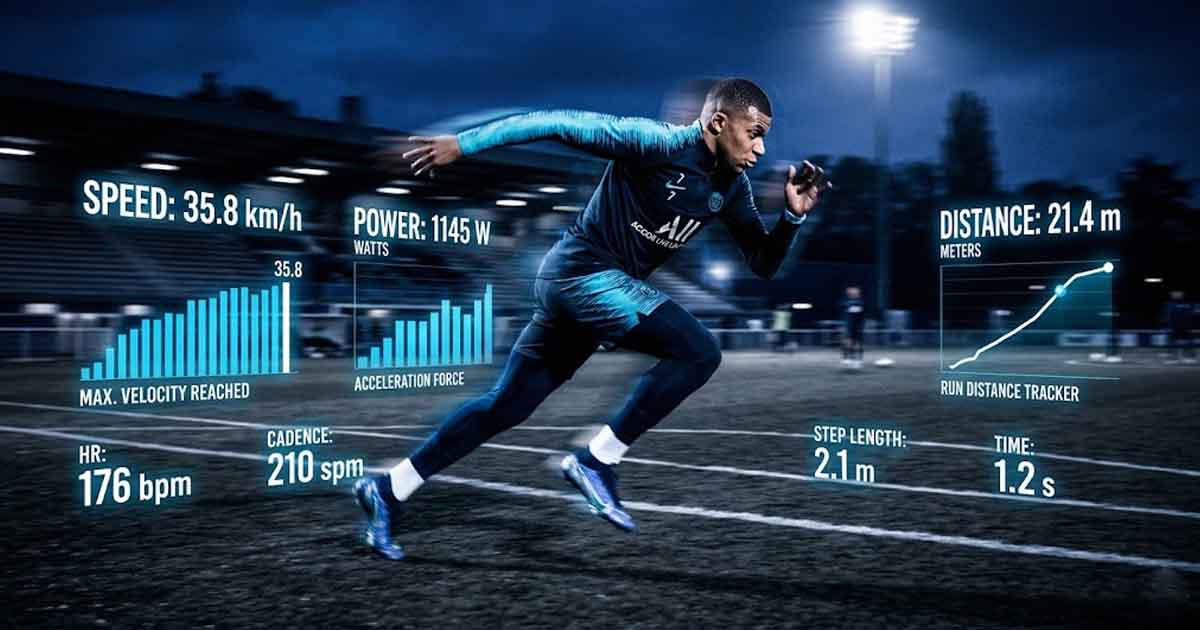
Kylian Mbappé operates at a physical level that places him among the fastest human beings ever to play professional football. His peak sprinting speed has been recorded in excess of 38 km/h — a figure that approaches the top speed of elite track sprinters — and he sustains this explosive output over 90 minutes while simultaneously executing the technical and tactical demands of playing for the world's most scrutinized football club at Real Madrid.
Understanding the training and nutritional foundations that enable this performance provides insight not just into how elite athletes prepare, but into the principles of speed and power development that can benefit footballers and athletes at every level.
The Foundation: Speed as a Trained Quality
The first thing to understand about training for speed is that it is substantially trainable — contrary to the myth that top-end pace is purely genetic. While genetics does set a ceiling on maximum sprint velocity, most athletes operate well below their genetic ceiling, and structured speed training can produce dramatic improvements in sprint times and first-step quickness. Mbappé's extraordinary pace reflects both exceptional genetic endowment and years of disciplined speed training.
The key elements of speed training for footballers are: acceleration mechanics (the ability to generate maximum velocity in the shortest possible distance — the 0-10 meter zone where most football sprints occur), maximum velocity mechanics (technical optimization of the full sprint cycle at top speed), and speed endurance (the ability to reproduce explosive efforts repeatedly across a 90-minute match).
Sprint Mechanics: The Technical Foundation
Optimal sprint mechanics — the biomechanical patterns that maximize sprinting efficiency — include high knee drive that extends stride length, proper arm mechanics that counterbalance lower body rotation, forward lean that allows gravity to assist acceleration in the first phase, and a mid-to-forefoot strike pattern that minimizes ground contact time and maximizes force application. Speed coaches working with Mbappé and other elite sprinting footballers spend substantial time on technical refinement of these mechanics, understanding that small improvements in efficiency at top speed translate to significant competitive advantages.
Strength Training: The Engine Room
Sprinting speed is produced by muscular force — specifically, the ability to apply large horizontal forces to the ground in a short time. The strength training program that supports sprint development therefore emphasizes posterior chain development: glute, hamstring, and calf strength that generates the propulsive force of each stride. Key exercises include Romanian deadlifts, Nordic hamstring curls (which directly train the muscle-length position most vulnerable to hamstring injury), hip thrusts, and single-leg plyometric work.
Mbappé's strength program is built around functional movements that transfer directly to football-specific patterns rather than isolated machine-based training. Compound movements — those that require coordination across multiple joints — produce more transferable athletic strength than isolation exercises and also develop the inter-muscular coordination that underpins explosive athletic output.
Recovery: The Secret Weapon
The training that produces Mbappé's extraordinary physical qualities is only part of the picture. The recovery practices that allow that training to be absorbed, and that maintain his physical capacity across a grueling fixture schedule, are equally important. Modern elite football recovery protocols include cold water immersion to reduce inflammatory response after matches, sleep optimization including extended sleep hours and careful attention to sleep environment quality, active recovery sessions involving low-intensity movement to facilitate metabolic clearance, and nutritional recovery protocols emphasizing timely carbohydrate and protein intake after training and competition.
Nutrition: Fueling Elite Performance
Mbappé's nutritional approach reflects the principles now standard across elite football: high carbohydrate intake to fuel the high-intensity sprint work that characterizes modern football, adequate protein to support muscle repair and adaptation, careful attention to hydration status across training and competition, and individualized nutrition planning that accounts for his specific training loads and match schedule. Players of Mbappé's intensity of output require approximately 8-10 grams of carbohydrate per kilogram of body weight on high-intensity training days — a figure that significantly exceeds the intake of even health-conscious recreational athletes.




Add a Comment