
The central midfielder in modern football is the position with the most physically demanding profile in the game. Data from top European leagues consistently shows that central midfielders cover between 11 and 13 kilometers per match — more than any other position — while repeatedly transitioning between high-intensity sprints, recovery running, defensive pressing, and technical actions in close-quarter situations. To excel physically in this position requires a combination of aerobic capacity, anaerobic power, speed endurance, and functional strength that makes midfield football one of the most physically demanding roles in professional sport.
This 8-week program is designed to build the specific physical qualities that central midfield demands, structured across three phases: an aerobic base phase, an anaerobic development phase, and a football-specific integration phase.
Phase 1: Weeks 1-3 — Building the Aerobic Engine
The aerobic energy system is the foundation of midfield performance. A high aerobic capacity — reflected in a high VO2 max — enables faster recovery between high-intensity efforts, meaning a midfielder with superior aerobic fitness can repeatedly sprint, press, and recover with shorter rest intervals than one with lower aerobic capacity. Phase one focuses on building this aerobic base through three types of training.
Continuous aerobic running at moderate intensity — approximately 65-75% of maximum heart rate — for 25-40 minutes develops basic aerobic efficiency. Tempo running at threshold intensity — approximately 80-85% of maximum heart rate — for intervals of 8-15 minutes improves the threshold at which lactic acid accumulates, directly extending the duration over which high-intensity football can be sustained. Small-sided games — 4v4 or 5v5 on reduced pitches — provide aerobic training stimulus in football-specific patterns that build position-specific fitness alongside the general aerobic qualities.
Phase 2: Weeks 4-6 — Developing Anaerobic Power
Phase two shifts the focus to the anaerobic energy systems that fuel the high-intensity efforts that define midfield play — the pressing sequences, the box-to-box runs, the recovery sprints after losing possession. High-Intensity Interval Training becomes the dominant training modality. Intervals of 15-30 seconds at maximum effort with work-to-rest ratios of 1:2 or 1:3 train the phosphocreatine and glycolytic systems that power these explosive efforts.
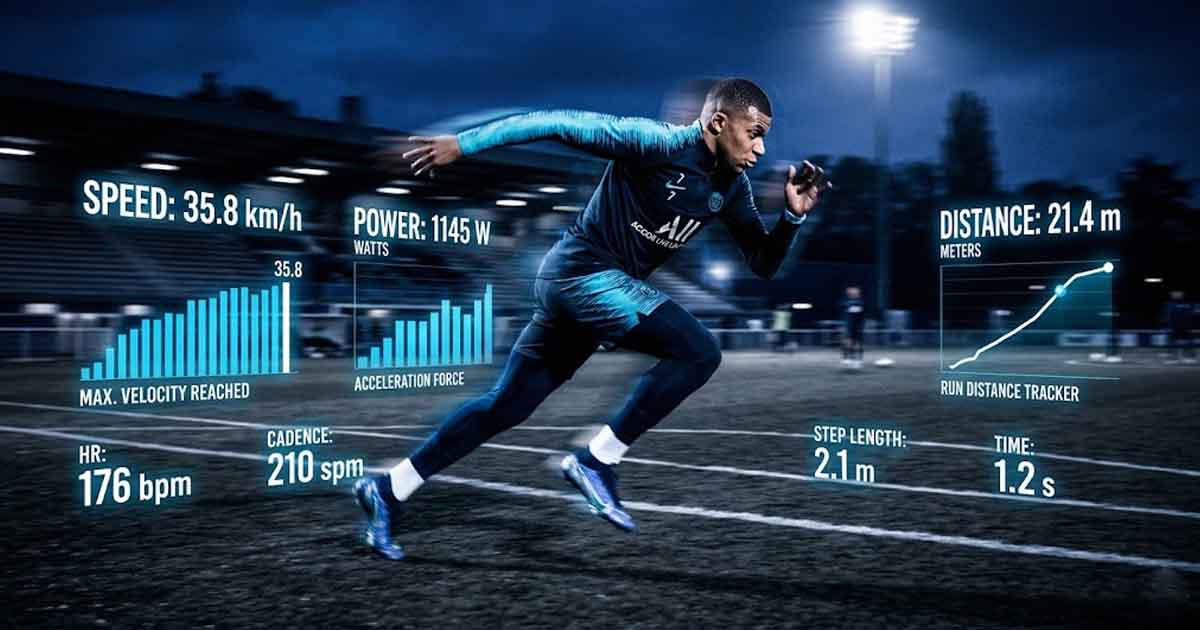
Repeated sprint training — sets of 6-10 sprints of 20-40 meters with brief rest periods — develops the specific capacity to reproduce high-speed efforts with incomplete recovery, which is precisely what pressing football demands. The decline in sprint speed across a set of repeated efforts reflects the anaerobic endurance quality being trained, and progressive improvement in sprint maintenance across the set indicates genuine fitness development.
Phase 3: Weeks 7-8 — Football-Specific Integration
Phase three integrates the physical qualities developed in phases one and two into football-specific patterns. Large-sided games on full-size or near-full-size pitches provide the most specific training stimulus for match fitness. Positional games that emphasize the specific movement patterns of the central midfield role — drop-and-receive, third-man runs, press-and-recover sequences — develop fitness and technical execution simultaneously.
Strength training throughout all three phases focuses on the functional movements that support midfield performance: single-leg strength work for the lateral acceleration demands of midfield movement, rotational core training for the body contact situations midfielders encounter, and hip flexor and hip extensor development for the repeated sprinting demands of high-volume covering. Two to three strength sessions per week throughout the program complement the conditioning work.




Add a Comment