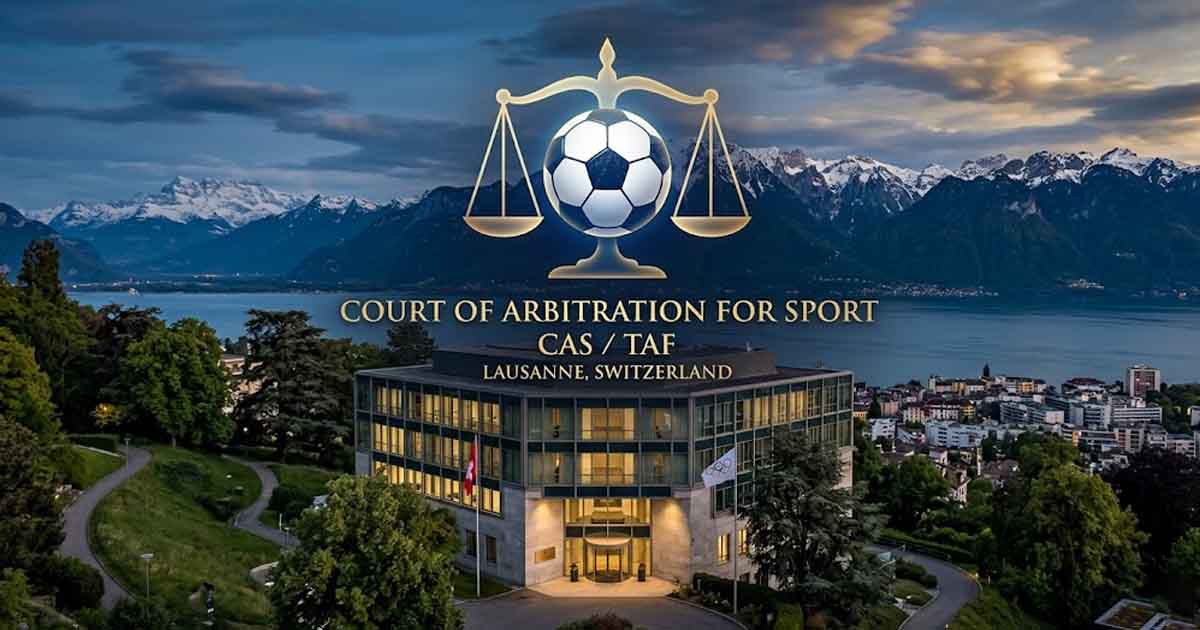
When disputes arise in professional sport — between athletes and clubs, between clubs and governing bodies, between players and their federations — the resolution rarely happens in a national court. Instead, it happens in Lausanne, Switzerland, at the Court of Arbitration for Sport: the supreme judicial body of international athletics and the institution that has done more than any other to create a coherent legal order for global sport.
The CAS was established in 1984 under the auspices of the International Olympic Committee and became operationally independent in 1994 following concerns about its proximity to the IOC. Today it handles thousands of cases per year, covering everything from doping violations and transfer disputes to disciplinary appeals and eligibility challenges, across virtually every sport practiced at international level.
How the CAS Works
The CAS operates three primary divisions. The Ordinary Arbitration Division handles disputes between parties — typically contractual or commercial disputes — that are submitted directly to the CAS rather than emerging from a disciplinary process. The Appeals Arbitration Division handles challenges to decisions already made by sports governing bodies, federations, or leagues. The Ad Hoc Division operates at major events like the Olympic Games, providing on-site dispute resolution within days or even hours when event participation is at stake.
Cases before the CAS are decided by panels of arbitrators drawn from the CAS list, which includes several hundred lawyers and former judges with expertise in sports law from dozens of countries. Parties typically each appoint one arbitrator, with the third — the president of the panel — either agreed jointly or appointed by the CAS itself.
Why Athletes and Clubs Use Arbitration
Arbitration offers several advantages over national court litigation for sports disputes. Speed is the most significant: a CAS panel can deliver a final award in weeks or months, whereas national court litigation in complex cases can take years. Confidentiality is also important — arbitration awards are not automatically public, which allows sensitive commercial or personal matters to be resolved privately.
The international enforceability of CAS awards under the New York Convention on the Recognition and Enforcement of Foreign Arbitral Awards is a further critical advantage. A CAS award can be enforced in over 160 countries without the need for a fresh court judgment in each jurisdiction — essential when dealing with clubs and athletes operating across multiple national territories.
Landmark CAS Decisions
Several CAS decisions have had profound impact on the development of sports law. The Pistorius case, in which Oscar Pistorius successfully appealed an IAAF decision that had barred him from competing in able-bodied competition, established important principles about the burden of proof in equipment-related eligibility disputes. The Landis and Armstrong cases established precedents for how anti-doping violations interact with sporting results and financial claims. Transfer cases involving Webster, Matuzalem, and others have shaped how compensation for breach of player contract is calculated under FIFA regulations.
Criticism and Reform
The CAS system is not without critics. Questions have been raised about the true independence of the institution from powerful governing bodies like FIFA and the IOC, the cost and complexity of proceedings for smaller athletes and clubs, and the consistency of decision-making across different panels. Reform proposals have included strengthening procedural protections for athletes, increasing transparency through mandatory publication of awards, and creating specialized divisions for specific sports.
Despite these criticisms, the CAS remains the foundational institution of sports justice globally, and its role is likely to grow as sport becomes increasingly global and the commercial stakes of sporting decisions continue to escalate.

Add a Comment