Artificial intelligence in sport is no longer a future state — it is the present operational reality of elite performance at every level from academy development to Olympic preparation. The conversation has shifted from whether AI will change sport to which specific AI applications are producing the most significant competitive advantages, which are overhyped relative to their actual impact, and what the next generation of AI deployment looks like. In 2026, those questions have clear answers.
Performance Analytics: Where AI Has Delivered the Most
The highest-impact AI deployment in elite sport is in performance analytics — the processing of large, complex datasets to extract insights that inform coaching and performance decisions. The scale and speed advantages that AI brings to this domain are not incremental improvements over human analysis — they represent a categorical difference in what is analytically possible.
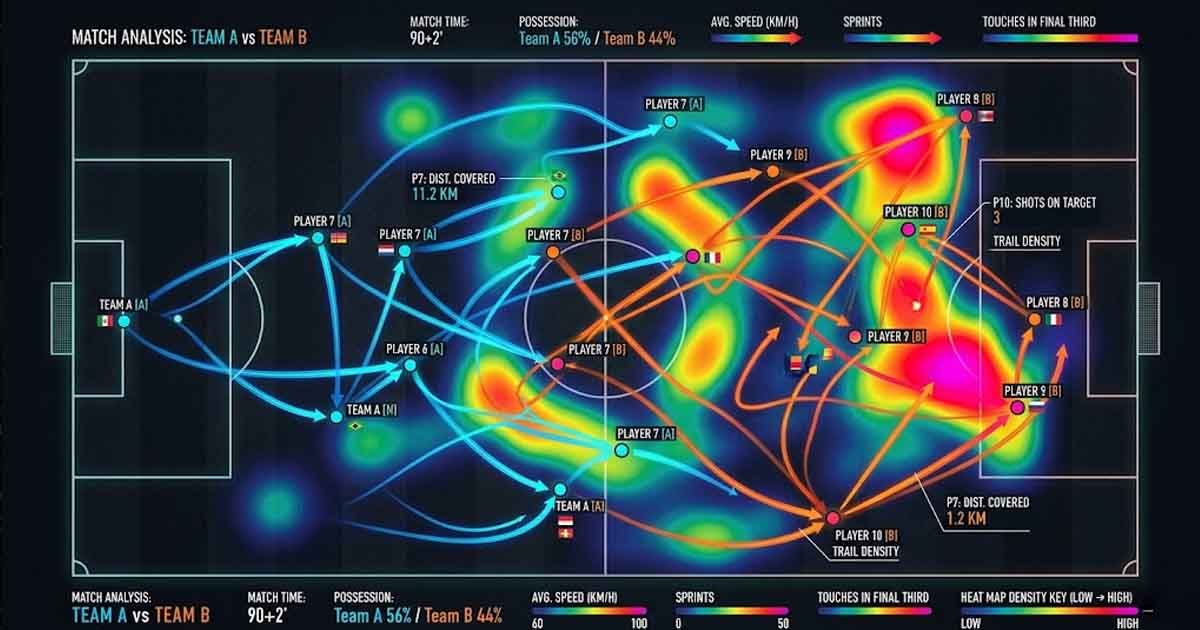
Computer vision systems that automatically track every player and ball position across every frame of match footage have replaced the manual tagging that previously required dozens of analyst hours per match. These systems generate datasets of several million data points per match — positional data, movement vectors, speed profiles, physical contact events, ball possession sequences — that human analysts could never process comprehensively. The AI layer extracts tactically relevant patterns from this data: the team's pressing triggers, the opponent's defensive shape transitions, individual player movement tendencies under specific game state conditions.
The most sophisticated implementations in 2026 are not producing descriptive reports about what happened — they are generating predictive models. Systems trained on millions of historical matches can identify, in real time during a game, the probability that a specific tactical situation will result in a goal or a goal concession, allowing coaching staff to trigger tactical interventions before outcomes that historical data predicts are occurring. This predictive dimension represents the frontier of AI analytics deployment and is currently limited to the most resource-rich organisations, but is expected to reach broader deployment within two to three years.
AI in Talent Identification and Development
Talent identification — the prediction of which young athletes will reach elite levels — is one of the oldest challenges in sport and one where human judgment has historically been unreliable in well-documented ways: recency bias, physical maturity bias, cognitive biases toward athletes who resemble previously successful players. AI-assisted talent identification systems attempt to address these biases by identifying objective performance characteristics at specific developmental stages that predict senior elite performance, regardless of the athlete's current physical stature or visual resemblance to successful predecessors.
The evidence for AI talent identification systems is mixed but improving. Systems trained on large, longitudinal datasets — tracking athletes from early development through senior performance across multiple cohorts — have demonstrated that specific combinations of movement quality, decision-making speed, and adaptability metrics at age 14-16 predict senior performance more reliably than traditional scout assessments. The important limitation is that these systems require high-quality longitudinal data to train effectively, which is available primarily at clubs that have maintained sophisticated data collection for a decade or more.
In player development, AI systems now monitor individual technical development across thousands of training repetitions, identifying pattern deviations from optimal movement mechanics that coaches cannot reliably detect through visual observation. These systems — deployed as camera arrays in training facilities with real-time computer vision analysis — provide granular technical feedback at a scale and consistency that individual coach attention cannot replicate. The practical impact on development speed has been documented by several academy programmes that have deployed these systems.
Natural Language AI in Coaching and Management
Large language model applications have entered the coaching and sports management domain, providing AI-assisted tools for tactical planning document generation, opponent analysis report drafting, athlete communication drafting, and information retrieval from large historical performance databases. These tools do not replace human judgment — they reduce the administrative burden that consumes significant portions of coaching staff time, freeing capacity for the human elements of coaching that AI cannot replicate. The coaching organisation that has integrated AI administrative support effectively is producing the same quality of human interaction with athletes while processing significantly more analytical information — a genuine operational advantage.
AI in Broadcasting and Fan Experience
Outside the performance domain, AI is reshaping how sport is broadcast and consumed. Automated highlight generation — AI systems that identify and extract the most compelling moments from live sport using engagement metrics, crowd audio analysis, and event detection — now operates at multiple major broadcasters, producing highlight packages within minutes of events rather than the hours required for human editorial assembly.
Personalised broadcasting — AI-curated content streams that adapt to individual viewer preferences, emphasising the players, teams, and storylines each viewer has demonstrated most interest in — is the commercial frontier. Several major streaming platforms are in advanced deployment of personalised sports coverage that goes beyond simple camera angle selection to fundamentally different editorial narratives for different viewer segments. The technology is mature; the commercial and rights framework for its broad deployment is still being negotiated.
The implication for sport's commercial future is significant: AI-enabled personalisation dramatically expands the audience that finds any given sport product engaging, because the product can be adapted to each viewer's specific interests rather than broadcasting to the average viewer. For sports properties, this represents a potentially transformative expansion of addressable audience and commercial value.



Add a Comment