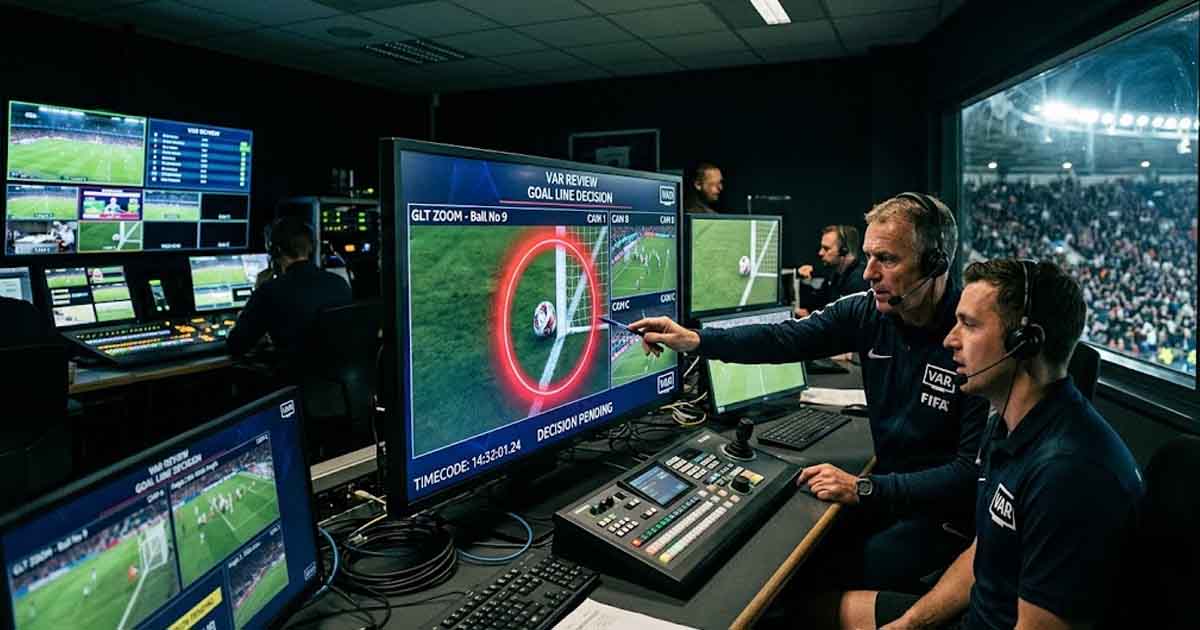
The introduction of goal-line technology to professional football in 2012 was, in retrospect, the opening act of a technological revolution that would progressively challenge one of football's most fundamental characteristics: the authority of the human referee. In just over a decade, technology has moved from a single narrow application — confirming whether the ball has fully crossed the goal line — to a system that reviews virtually every significant decision in top-level football.
The VAR debate is one of the defining tensions in modern football. The technology undeniably corrects genuine errors — clear and obvious mistakes in major decisions that would otherwise distort results. But its implementation has generated frustration, confusion, and the widespread sense that something essential about football's emotional immediacy has been sacrificed at the altar of accuracy.
Goal-Line Technology: The Clear Success Story
Goal-line technology — implemented in the Premier League and at the 2014 World Cup — is the one area of football technology that commands near-universal approval from players, managers, fans, and referees alike. The system uses either high-speed camera triangulation or electromagnetic field sensors to determine within millimeters whether the ball has fully crossed the goal line, communicating the result to the referee's watch within one second.
The case for goal-line technology is straightforward: it eliminates entirely a category of decision where human perception is genuinely unreliable under the conditions of professional football, where the ball may cross the line by a centimeter at high speed while being partially obscured by a crowd of players. The Frank Lampard goal in the 2010 World Cup — clearly over the line, not given, arguably contributing to England's exit — remains the definitive argument for why goal-line technology was necessary.
VAR: The More Complicated Story
The Video Assistant Referee system — first implemented experimentally in 2018 and now standard at the top levels of most major leagues — operates on a fundamentally different principle from goal-line technology. Rather than providing objective measurement of a discrete physical fact, VAR involves human beings reviewing video footage of subjective decisions — offsides, handballs, fouls, red card incidents — and determining whether the on-field referee's original call constitutes a "clear and obvious error."
The implementation of this principle has been deeply inconsistent across leagues, referees, and competitions. The definition of "clear and obvious" has proved almost impossible to apply consistently. The offside system — which uses semi-automated technology to draw lines from player body parts, determining offsides by centimeters that are themselves within the margin of measurement error — has produced decisions that feel arbitrary and technically generated rather than humanly judged.
Semi-Automated Offside Technology
The most recent technological development in football officiating is semi-automated offside technology (SAOT), which uses a network of cameras to track the positions of all players simultaneously, creating a three-dimensional spatial model that allows offside decisions to be generated algorithmically rather than requiring a human to draw a line frame by frame on a video image. FIFA deployed SAOT at the 2022 World Cup and reported that offside decisions were being generated in an average of 25 seconds — dramatically faster than the minutes-long checks that plagued earlier VAR implementations.
The technology is impressive in its precision but has raised philosophical questions about what offside is for. The law was designed to prevent goal-hanging — positioning an attacker ahead of the last defender for an unfair advantage. Whether a player's armpit being 2cm offside when the ball is struck by a teammate represents the kind of unfair advantage the law intended to address is a question that technology alone cannot answer.
What Comes Next
The trajectory of technology in football officiating points toward continued expansion. Automated foul detection using AI analysis of player movement patterns is in development. Real-time tracking of player positions relative to structured formations for tactical offside traps may eventually be possible. The central question for football's governing bodies is how much of the game's human character they are willing to trade for technical accuracy — a balance that different stakeholders weigh differently, and that will continue to generate debate for as long as the sport is played.


Add a Comment