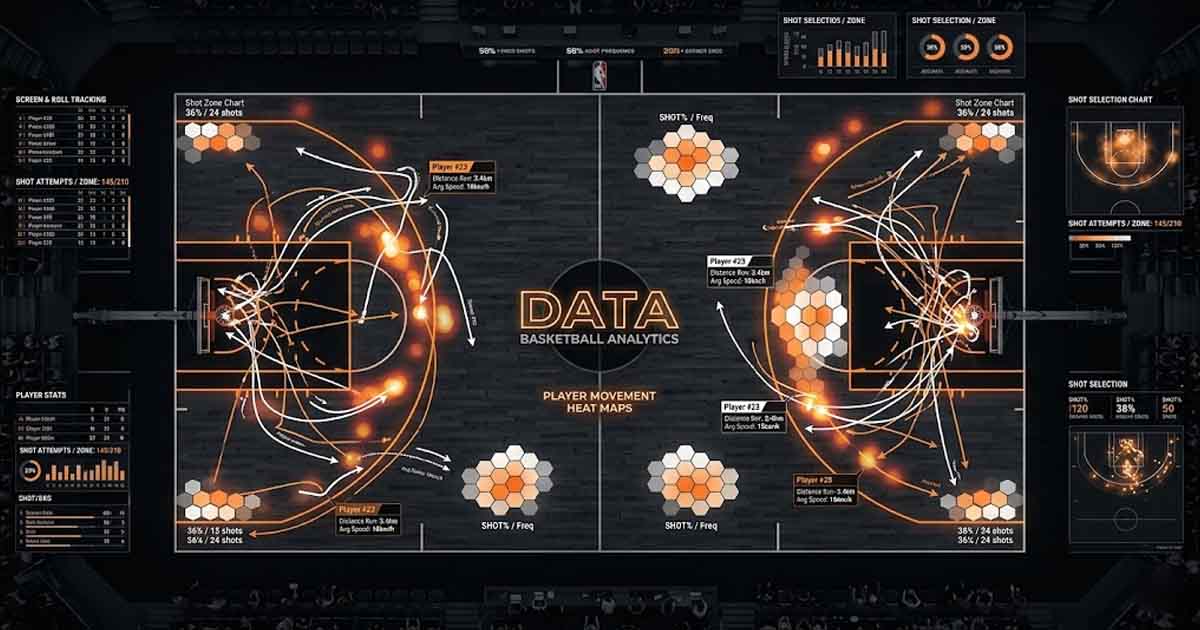
The NBA's analytics revolution began in earnest in the early 2000s — earlier than most people realize — when teams like the Houston Rockets, then run by GM Daryl Morey, began applying economic and statistical principles to player evaluation and game strategy. Two decades later, the league has become arguably the most analytically sophisticated major professional sports competition in the world, with data science capabilities embedded at every franchise and influencing decisions from draft picks to in-game substitutions.
Understanding how NBA analytics works — what the key metrics measure, how they are used in practice, and where the limits of the current approaches lie — illuminates not just basketball strategy but the broader relationship between data and decision-making in high-stakes competitive environments.
The Shot Quality Revolution
The most consequential analytical insight in NBA history is the devaluation of the mid-range jump shot. This seems counterintuitive — mid-range shooting is a beautiful and technically demanding skill — but the mathematics are clear. A shot from 18 feet counts for two points. A shot from 24 feet counts for three. A shot at the rim generates the highest field goal percentage of any location on the floor. The expected value — field goal percentage multiplied by points per shot — of mid-range jumpers is lower than either three-pointers or shots at the rim.
Teams that internalized this insight — the Rockets under Morey being the paradigmatic example — restructured their entire offensive systems to eliminate mid-range attempts in favor of threes and rim attacks. The Golden State Warriors took this further by developing a system where elite three-point shooting created spacing that enabled superior ball movement and higher-quality looks throughout the offensive structure.
Player Tracking: From GPS to Optical Monitoring
Since 2013, every NBA arena has been equipped with an optical tracking system — originally from SportVU, later replaced by Second Spectrum — that captures the three-dimensional position of every player and the ball 25 times per second throughout every game. This data enables analysis that was simply impossible before: how far players travel over the course of a game, their speed on cuts and transitions, the spatial relationships between their movement patterns and shot creation.
From this tracking data, teams generate metrics including open shot percentage (what proportion of shots are attempted with the nearest defender more than four feet away), defensive range (how much ground a player covers defending without compromising their positioning), and screen involvement (how many screens a player sets and how effectively they generate offensive advantages). These metrics, invisible to the naked eye, provide a richer picture of player value than traditional counting statistics.
Lineup Analysis and Rotation Optimization
One of the most practical applications of NBA analytics is lineup analysis — evaluating the net point differential generated by different combinations of five players over statistically meaningful sample sizes. This analysis enables coaches to identify which combinations perform best in which contexts — whether a specific lineup excels defensively against pick-and-roll heavy offenses, or whether a particular five-man unit generates disproportionate advantages in transition.
Modern lineup analysis has moved beyond simple plus-minus statistics to incorporate adjusted net rating metrics that account for the quality of the lineups faced, and Machine Learning approaches that attempt to project performance of lineup combinations that have not yet been deployed together. The depth of analysis available to NBA coaching staffs in 2026 would be incomprehensible to the coaches of two decades ago.
The Human Element: Where Analytics Meets Judgment
Despite the extraordinary sophistication of NBA analytics, every successful franchise emphasizes that data is a tool for human judgment rather than a replacement for it. Metrics cannot fully capture leadership, competitive character, team chemistry, or the psychological dimensions of clutch performance. Draft decisions, in particular, involve assessments of character, coachability, and developmental potential that the most sophisticated models cannot reliably quantify.
The most successful NBA organizations — the Golden State Warriors, Boston Celtics, and Miami Heat among them — have developed cultures where analytical rigor and basketball intuition coexist and inform each other. Data surfaces questions and challenges assumptions; experienced basketball minds interpret the data and make final judgments. The integration of these two modes of thinking, rather than the dominance of either, is what characterizes the sport's leading organizations.









Add a Comment