Biomechanics — the application of mechanical principles to the analysis of human movement — has been practised in sports science laboratories since the 1970s. For most of that history, the laboratory was a genuine constraint: the equipment required for precise movement analysis was expensive, stationary, and incompatible with the ecological conditions of actual training and competition. Athletes were brought to the laboratory, asked to perform in constrained conditions, and the resulting data was extrapolated to real-world performance. The limitations of this approach were well-recognised by practitioners but tolerated because no better option existed. In 2026, that constraint has been substantially lifted.
The Democratisation of Motion Capture
Optical motion capture — the gold standard for three-dimensional movement analysis, using reflective markers tracked by calibrated camera arrays — has become significantly more accessible in 2026 through two parallel developments. First, the cost of the hardware has fallen dramatically: a motion capture system capable of clinical-grade movement analysis now costs a fraction of equivalent systems from a decade ago. Second, markerless motion capture systems — which use computer vision algorithms to extract three-dimensional body pose from standard camera footage without requiring markers to be attached to the athlete — have reached accuracy levels sufficient for most clinical and performance analysis applications.
Markerless systems are particularly significant for sport application because they eliminate the equipment attachment requirement that made marker-based capture ecologically invalid for many sporting movements. An athlete running at maximum speed on a track, a tennis player executing a serve, a swimmer in open water — all can now have their movement analysed in three dimensions without any physical preparation that might alter the movement being analysed. The ecological validity advantage transforms what biomechanics analysis can tell us about actual sport performance.
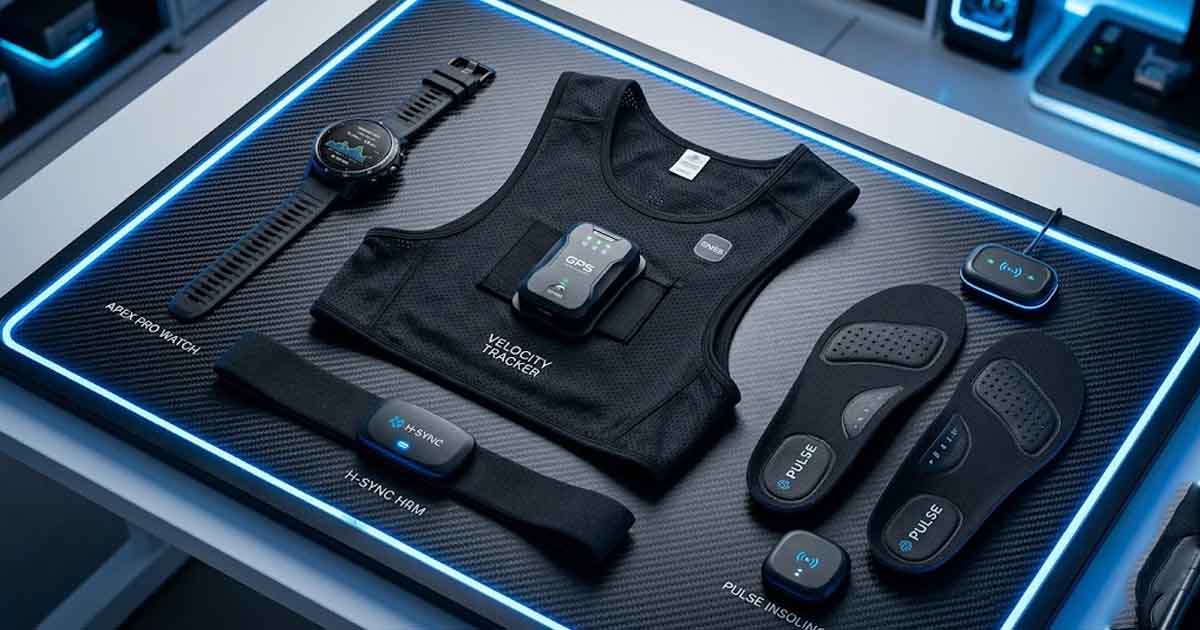
Wearable inertial measurement units (IMUs) — small sensor packages containing accelerometers, gyroscopes, and magnetometers that can be attached at multiple body locations — have a different profile of advantages. They are fully portable, require no calibrated camera infrastructure, and operate in any environment including on-field training and competition. Their measurement of joint angles and segment kinematics is less precise than optical systems but sufficient for many performance and injury risk assessment applications, and their operational simplicity enables routine use at a frequency that laboratory visits cannot match.
Force Measurement Technology in Training Contexts
Force plate technology — platforms that measure the three-dimensional forces produced when an athlete contacts them — has historically been laboratory equipment. Portable force plates that can be deployed on training fields, incorporated into starting blocks, or placed under specific equipment have expanded force measurement to training contexts that would previously have required laboratory visits.
The athletic performance applications are direct: jump height measurement, landing force asymmetry assessment, sprint force-velocity profiles, and weightlifting force production curves are now routinely measured at training facilities rather than requiring laboratory visits. The injury assessment applications are equally valuable: force plate assessment of landing mechanics following ACL reconstruction provides objective measurement of the bilateral asymmetry that indicates incomplete neuromuscular recovery and elevated re-injury risk — a measurement that clinical observation cannot provide with equivalent precision.
Real-Time Feedback Systems in Technical Training
The combination of biomechanics measurement capability with real-time feedback delivery is the most practically powerful development for skills acquisition applications. Systems that measure relevant biomechanical parameters in real time and provide immediate, specific feedback through audio, visual, or haptic channels can compress the learning timeline for technical skills significantly compared to feedback delayed until review sessions. Research on augmented feedback in motor learning consistently shows that immediate, specific, accurate feedback produces faster skill acquisition than delayed feedback — and real-time biomechanics measurement makes this kind of feedback available for complex sports movements that were previously beyond real-time assessment capability.
Injury Risk Assessment Through Movement Screening
Biomechanics technology has produced its most documented performance impact in injury risk assessment. Movement screening protocols — standardised assessments of functional movement quality that identify biomechanical risk factors for specific injury types — have been enhanced by technology that makes them more precise, more efficient, and more sensitive than clinical observation alone.
The three-dimensional analysis of landing mechanics — assessing knee valgus collapse, hip drop, trunk lean, and ground contact force asymmetry during standardised drop jumps — identifies athletes with elevated ACL injury risk with documented sensitivity. Programmes that have implemented regular movement screening and followed up identified risk factors with targeted intervention demonstrate reduced ACL injury rates compared to historical baselines. The technology investment required — portable force plates and markerless motion capture capable systems — is accessible to well-resourced elite programmes and increasingly to lower levels as costs continue to decline.

Add a Comment