When VAR was introduced to the Premier League in 2019, its proponents promised that it would eliminate the clear and obvious errors that changed game outcomes, reduce the advantage gained from simulation, and ultimately make the game fairer. Seven years later, the technology has delivered some of what was promised, created problems its designers did not anticipate, and generated a level of fan disengagement from the match-going experience that its creators did not adequately model in their predictions. The honest assessment of officiating technology in 2026 requires engaging with all of these realities.
What VAR Has Actually Achieved
The empirical record of VAR's impact on decision accuracy is positive in the categories where it was designed to help most. Analysis of Premier League decisions across the VAR era consistently shows that the rate of clear factual errors — obvious offsides, missed red card incidents captured by cameras — has fallen significantly compared to the pre-VAR era. The specific promise that the technology would eliminate "clear and obvious errors" that directly change game outcomes has been substantially delivered for the factual components of decision-making.
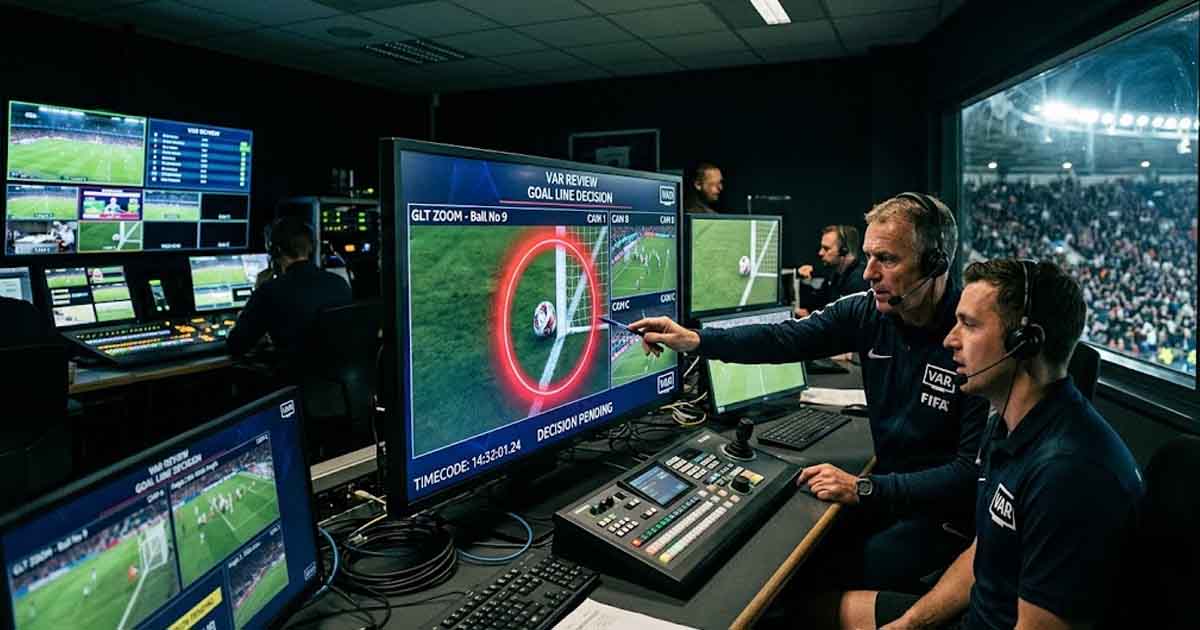
Goal-line technology, introduced before VAR and now so routine that it rarely generates discussion, is universally acknowledged as a successful officiating technology implementation: it resolves a specific factual question (did the ball cross the line?) with certainty, quickly, and without the interpretive ambiguity that makes other officiating decisions contentious. The contrast between goal-line technology's reception and VAR's is instructive: technology that resolves factual questions cleanly is universally positive; technology that attempts to sharpen the application of inherently interpretive rules produces the disputes that have characterised VAR's controversy.
Where VAR Has Failed to Meet Expectations
The dissatisfaction with VAR is concentrated in several specific areas that were either not adequately addressed in the technology's design or were not amenable to technological solution regardless of implementation quality.
Offside determination using the current semi-automated line-drawing technology has produced absurd outcomes that have severely damaged fan confidence in the system. Millimetre offside decisions — technically correct within the measurement system's defined accuracy — communicate to fans that a player who is clearly not gaining an offside advantage is being penalised for a positional difference smaller than the natural variation in a player's position across frames. The resolution of the measurement system is greater than the precision of the underlying rule's intent, producing outcomes that are technically correct and intuitively wrong simultaneously.
The time taken for VAR reviews — particularly for subjective decisions like handball and penalty incidents — has fundamentally changed the match-going experience. The moments of collective goal celebration that define the emotional experience of attending live sport are now routinely deferred or extinguished as fans wait for VAR review outcomes that may arrive several minutes after the event. The psychological research on emotional experience clearly predicts that deferred and uncertain celebration is less satisfying than immediate celebration — and attendance and fan satisfaction data across VAR leagues show measurable post-VAR declines that cannot be fully explained by other factors.
Semi-Automated Offside: The Technology Update That Changed the Calculus
Semi-automated offside technology — using body-point tracking AI to generate instantaneous offside determinations — has significantly reduced the time required for offside VAR checks compared to the original manual line-drawing process. Deployed in the Champions League since 2022 and now in several top domestic leagues, the system provides accurate offside determinations in seconds rather than the minutes of the original system. This improvement addresses the timing problem partially, though the millimetre accuracy concern remains. The direction of travel — toward faster, more automated decision systems — is correct, but the fundamental tension between the technology's measurement precision and the rule's interpretive intent has not been resolved.
What Comes Next: The Technology Pipeline for Officiating
The next generation of officiating technology addresses several of VAR's limitations. Full body tracking systems — deployed in some competition environments — enable the automatic detection of foul contact events through force estimation, potentially reducing the subjective judgment required for contact-based decisions. AI systems trained on millions of historical foul and penalty decisions are in testing at several football governing bodies, with the goal of providing decision support that contextualises specific incidents within the full range of historical decisions rather than applying isolated judgment.
The fundamental question — whether officiating technology serves the game's entertainment value or primarily serves abstract notions of accuracy — has not been resolved and will continue to drive the debate about how much technology officiating should incorporate. The answer may ultimately differ between different competition contexts: the Champions League final and a community league match may legitimately apply different technology standards, with the highest-stakes competitions investing most heavily in accuracy and the community game preserving the human officiating experience that is part of its character.


Add a Comment